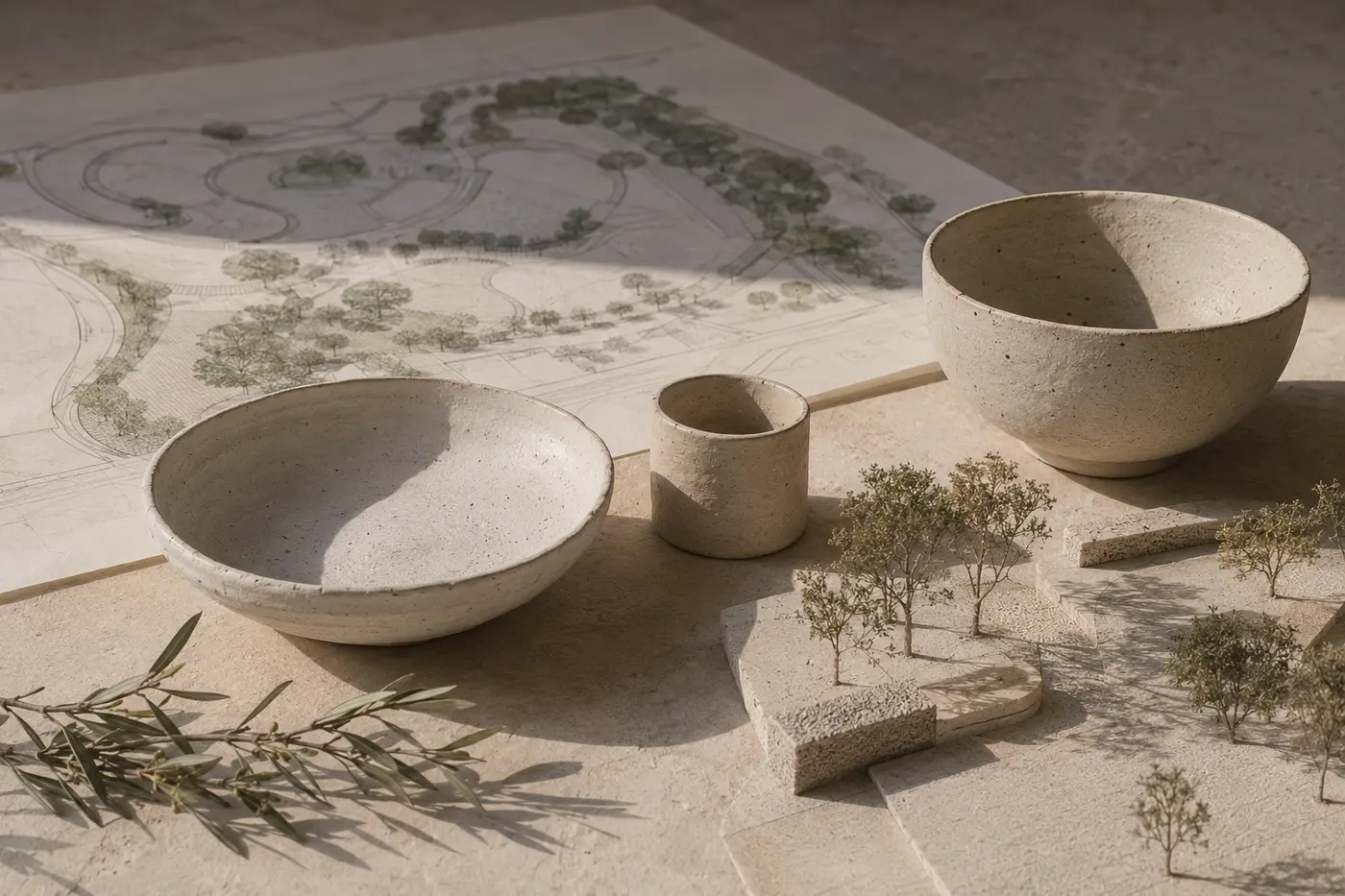
People often ask why a landscape architect would begin making ceramic objects. To me, the answer has always felt surprisingly simple. I never changed disciplines. I only changed scale. The questions remain remarkably similar.
Landscape architecture is often understood as the design of parks, streets and public spaces. Ceramics is often understood as the making of vessels and everyday objects. At first glance, they appear completely unrelated. One works across hectares. The other fits comfortably within two hands. Yet beneath these differences lies the same design process. Observation. Context. Material. Proportion. Time. Use. These principles remain unchanged regardless of scale.
When designing a public square, we rarely begin with paving. We begin with people. Where do they arrive? Where do they pause? Where do they seek shade? Where do conversations naturally happen? How does water move across the site? How does the sun change the space throughout the day? How will the place age over decades? Only afterwards do materials and forms begin to emerge.
The same sequence exists when designing an object. Before drawing a profile, I ask different questions. How does the hand approach it? Where does the thumb naturally rest? How does the rim meet the lips? How does light move across the surface during breakfast?
How does the object feel after years of everyday use? These are not decorative questions. They are questions of inhabitation.
Landscape architecture has taught me that design is rarely about isolated objects. It is about relationships. A bench only makes sense because of the tree beside it. A path only becomes meaningful because it connects places. A wall only matters because it creates shelter. Context gives every element its purpose.
Objects behave in exactly the same way. A bowl belongs to a table. A table belongs to a room. A room belongs to a house. A house belongs to a landscape. Nothing exists independently. Everything participates in a larger spatial system.
Perhaps this is why I think less about products than about environments. A ceramic object should never dominate a room. It should quietly contribute to its atmosphere. Just as a carefully placed tree transforms a square without demanding attention, an everyday object can subtly shape how a space is experienced. Its influence is measured through use rather than spectacle.
There is another lesson landscape architecture offers. Good public spaces encourage rituals. Morning walks. Children playing. Neighbours meeting. Reading beneath a tree. Lunch in the shade. These repeated actions gradually become part of a place's identity.
Objects participate in rituals too. The morning coffee. Bread shared at the table. Preparing food. Serving friends. The evening cup of tea. Over time, the object becomes inseparable from these moments. Its value lies not in its appearance but in the life that unfolds around it.
Scale changes. Human behaviour does not. Whether we design a city square or a small vessel, we are ultimately designing experiences. We are shaping movement.
Comfort. Touch. Memory. Atmosphere. One happens across hundreds of metres. The other across a few centimetres. The ambition remains identical.
This is perhaps why I have never considered Me Meraki to be separate from my work as a landscape architect. It is another way of exploring the same questions. What makes a space feel generous? What creates calm? How do materials influence emotion? How does time improve design rather than diminish it? These questions simply happen at table scale.
The objects developed through Me Meraki are therefore not miniature buildings. Nor are they sculptural landscapes. They are everyday companions shaped by the same principles that organise places. Proportion before expression. Climate before aesthetics. Material before decoration. Use before image. Time before perfection.
Perhaps this is the real relationship between landscape architecture and ceramics. Both are acts of hospitality. Both create conditions for people to gather. To pause. To share. To belong. One offers a place beneath a tree. The other offers a place at a table.
When I design a bowl, I often imagine a public square. Not because they look alike. But because both ask exactly the same question. How can this simple act of design make everyday life just a little more meaningful?