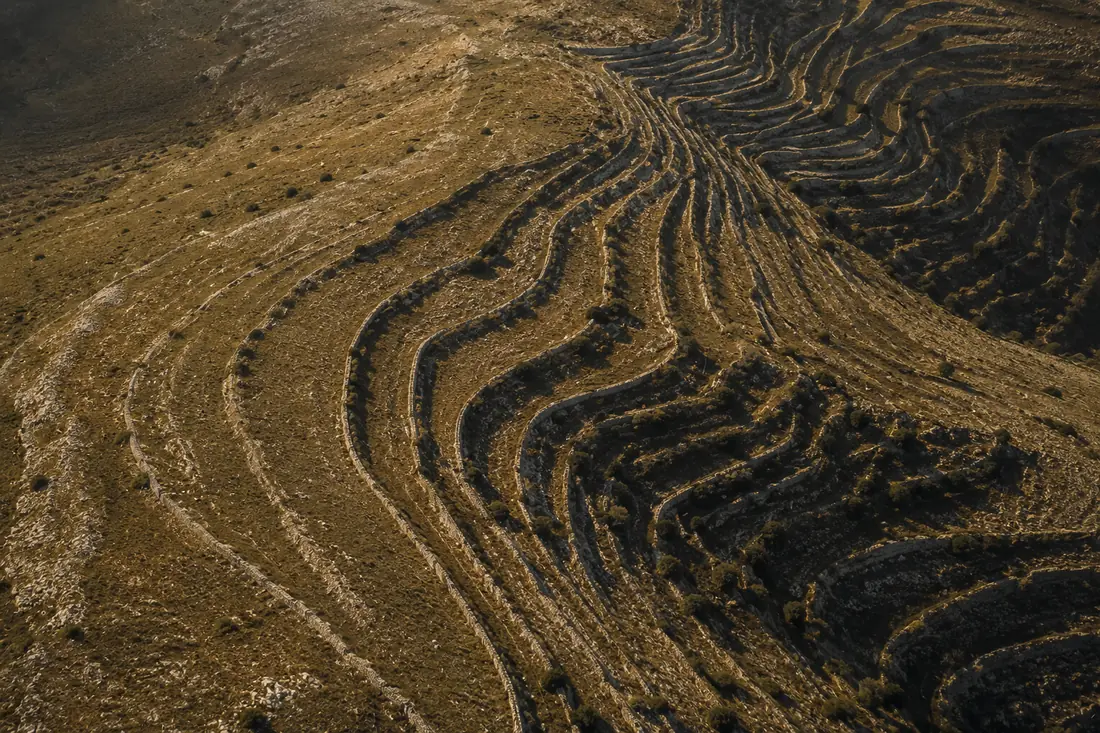
Most people encounter contours for the first time on a map. Thin lines. Numbers. Technical drawings. They appear abstract. Almost mathematical. Landscape architects learn something different. A contour is never just a drawing. It describes how a body moves through space. Where it slows. Where it climbs. Where it pauses. It tells us how gravity shapes experience.
Before construction begins, every landscape already possesses a hidden geometry. Water follows it.
Trees respond to it. People instinctively read it through their feet long before they understand it intellectually. The body recognises slope before the eye does. Walking uphill changes breathing. Descending changes balance. Even standing still feels different depending on the ground beneath us. Contours are therefore not simply measurements. They are experiences.
Perhaps this is why I rarely think about contour lines as information. I think about them as touch. A hillside is never perceived all at once. It unfolds gradually beneath our steps. Its shape is understood through movement. A drawing can describe elevation. Only walking can reveal the landscape.
This understanding has gradually entered the way I design objects. The hand reads form much like the body reads terrain. It does not analyse every curve. It discovers them. The fingers move. Pressure changes. The palm adjusts almost instinctively. Touch becomes another form of topography.
A ceramic vessel contains its own landscape. Its profile rises and falls. Its rim forms a horizon. Its interior becomes a small valley. Its base creates stability. Every curve influences how the hand travels across the object. The experience is not visual alone. It is physical.
Landscape architecture constantly reminds us that movement is never accidental. Paths curve because they respond to terrain. Steps become wider where people pause. Gradients soften where accessibility matters. Good landscapes guide without instructing. They allow the body to feel comfortable without consciously explaining why. Objects can achieve the same quiet intelligence.
Perhaps this is why I spend more time refining transitions than creating dramatic forms. A curve reduced by one millimetre. A softer radius. A slightly different angle where thumb meets rim. These adjustments are almost invisible. Yet the hand notices immediately. Just as a pedestrian notices a poorly designed slope without ever looking at a plan.
The Mediterranean offers endless lessons in contours.
Agricultural terraces wrapping around hillsides. Footpaths following natural ridgelines. Dry-stone walls tracing subtle changes in elevation. Nothing is imposed. Everything responds. The landscape teaches that form emerges from understanding existing conditions rather than resisting them.
Working with clay reinforces the same lesson. The wheel produces continuous movement. The hand guides rather than forces. Every profile grows from one uninterrupted gesture. The object remembers that movement. Its final form is not simply drawn. It is travelled.
Perhaps this is why I continue returning to landscapes whenever I feel uncertain in the studio. They remind me that every meaningful form begins with movement. Not movement as spectacle. Movement as understanding. The body discovering space. The hand discovering material. The eye discovering proportion.
Contours therefore become much more than a representation of land. They become a way of thinking.
A reminder that good design is rarely experienced all at once. It reveals itself gradually. Step after step. Touch after touch. Use after use.
Perhaps the most successful object is like the most successful landscape. You never stop to admire its contours. You simply feel completely at ease moving through them.