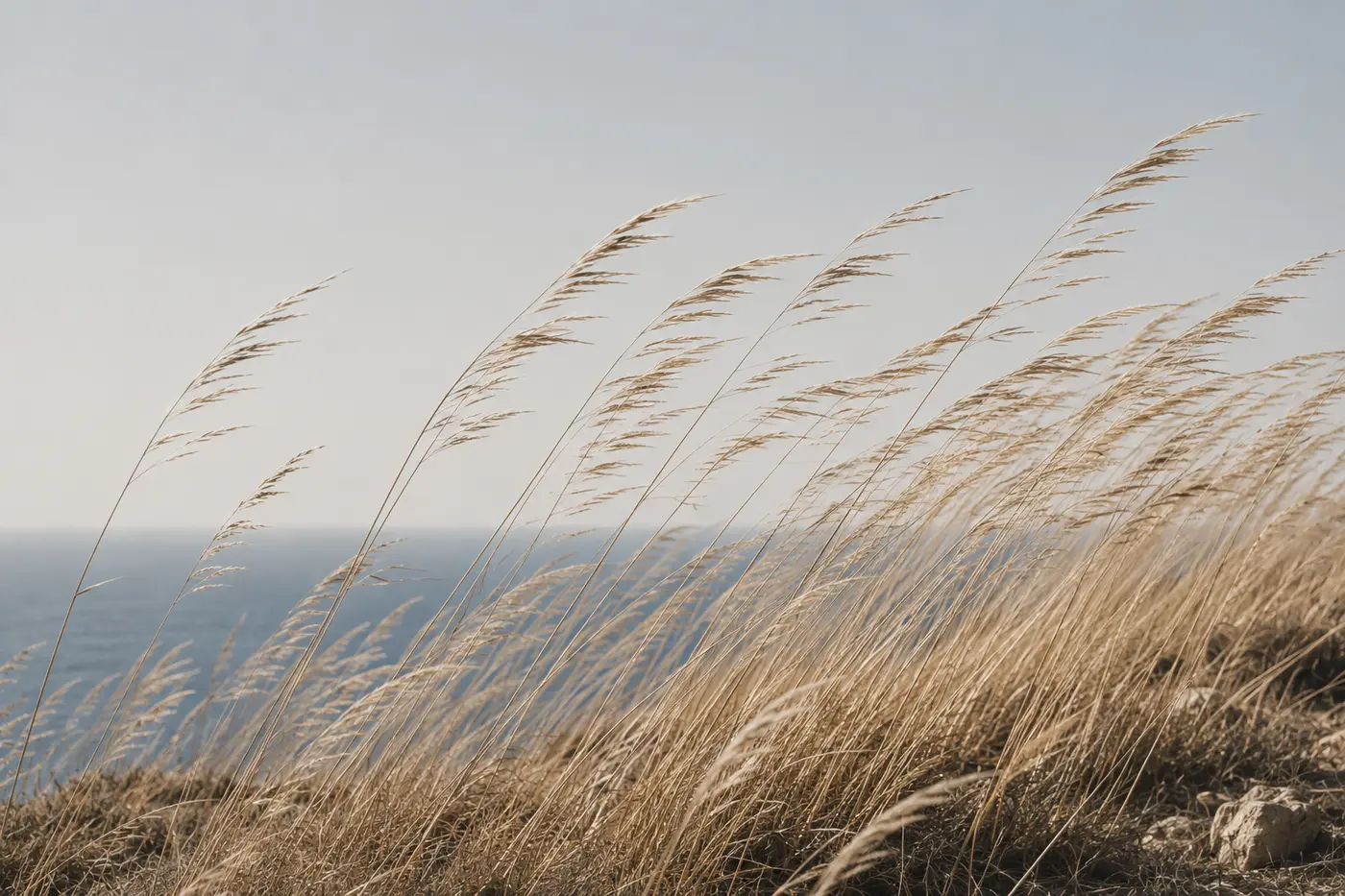
Wind leaves no permanent trace. It has no colour. No texture. No fixed form. Yet it is one of the strongest forces shaping the landscapes we inhabit. As landscape architects, we rarely begin by asking how a place looks. We ask how it behaves. How does water move? Where does shade fall? Which areas remain exposed? Where does the wind accelerate, slow down or change direction? These invisible systems determine whether a place feels comfortable long before we notice its visual qualities. Wind is one of them.
In Mediterranean landscapes, wind is never simply background climate. It becomes part of daily life. It shapes vegetation. It determines where people gather. It cools public spaces during summer. It erodes stone.
It carries salt from the sea. It bends grasses in a single direction. Over time, it leaves a visible record on the landscape without ever becoming visible itself. We only understand wind through its consequences.
Perhaps this is why I photograph grasses more often than skies. The sky tells me little. The grasses tell me everything. A single movement across a hillside can reveal the prevailing direction of the wind. Olive trees lean almost imperceptibly after decades of exposure. Reeds become temporary drawings, changing every second but always returning to the same rhythm. The landscape behaves like an instrument. Wind is simply the musician.
This way of observing has gradually influenced the objects I design. Movement does not require motion. An object can remain completely still while suggesting movement. A gently tapering profile. A subtle asymmetry. A rim that appears slightly lifted. A surface that catches changing light as someone walks around it. These are quiet gestures. They do not imitate wind. They acknowledge it.
Landscape architecture has taught me that successful design often works with natural forces rather than against them. Trees are positioned to filter prevailing summer winds. Courtyards are proportioned to encourage ventilation. Pergolas create filtered air rather than complete enclosure. The objective is rarely to eliminate wind. It is to transform it into comfort. This philosophy extends naturally to objects. Rather than imposing rigid perfection, I find myself interested in forms that feel balanced yet alive. Forms that appear settled but never static. Objects that suggest they have been gently shaped by environmental forces over time.
The Mediterranean offers countless examples of this quiet intelligence. Dry grasses never grow as identical vertical lines. They lean. Stone edges soften through centuries of exposure. Sand accumulates where the wind slows. Trees become sculptural without any designer intervening. The landscape demonstrates that movement and permanence are not opposites. They coexist. Perhaps this is why so many Mediterranean places feel timeless. They accept change rather than resisting it.
Working with clay has reinforced this understanding. The material itself responds continuously. It shrinks.
It dries. It settles. Even during firing, transformation continues. Control is necessary, but absolute control is impossible. The process rewards observation more than domination. In many ways, clay behaves like a landscape. It remembers every force applied to it.
Designing with wind therefore does not mean creating objects that resemble waves or swirling forms. It means understanding rhythm. Balance. Direction. Restraint. It means recognising that movement can exist without animation, just as wind can exist without being seen. The most enduring objects rarely shout. Like a line of grasses responding to the breeze, they communicate through subtle shifts rather than dramatic gestures.
Perhaps this is why I continue returning to the same question. How can an object feel alive while remaining completely still? The answer is rarely found in the studio. It is found outside. Watching the landscape move.