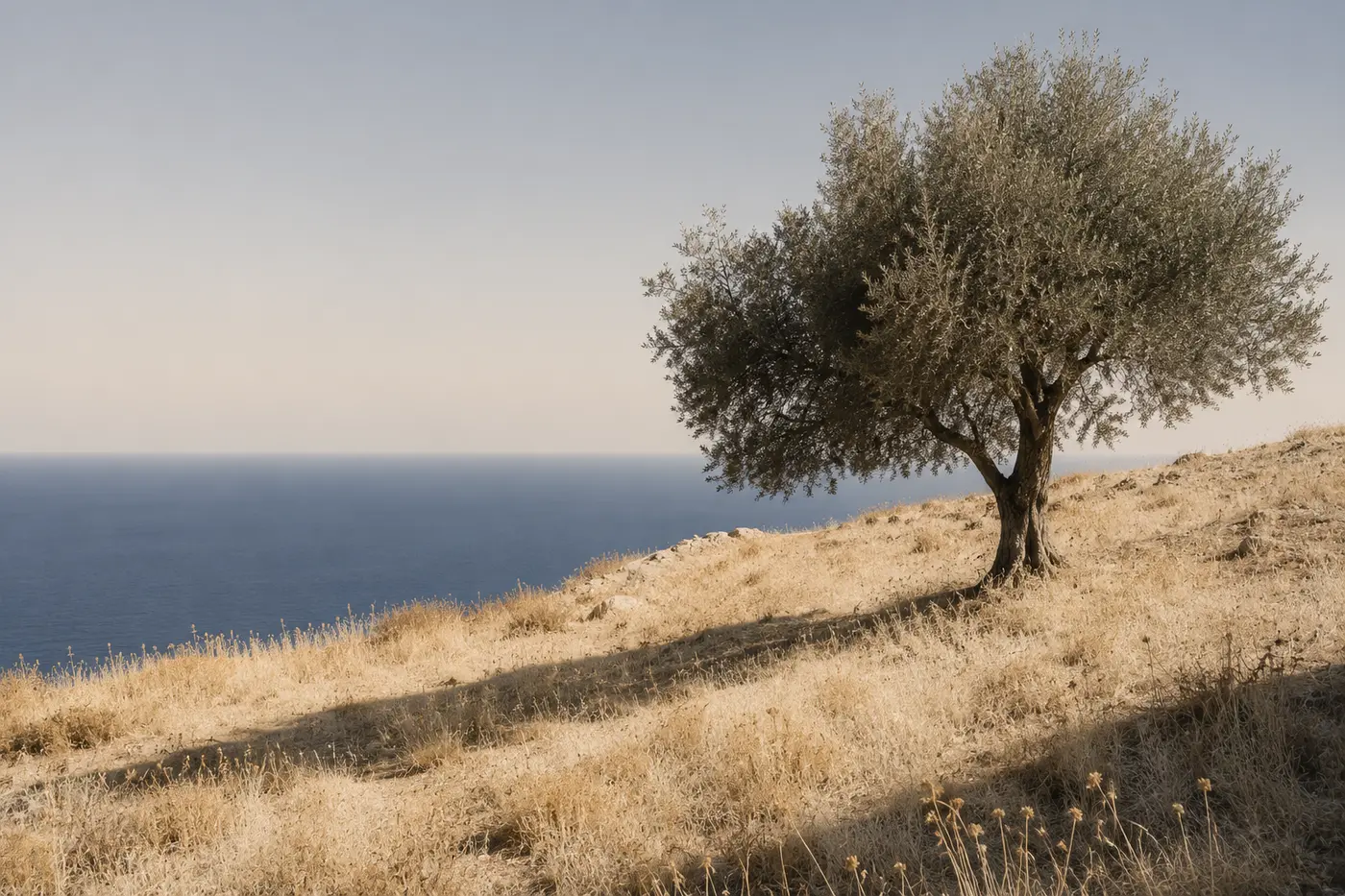
There is a moment every summer when the Mediterranean quietly changes. It is rarely noticed. No dramatic event announces it. There is simply less rain. The soil begins to harden. Grasses lose their green. Leaves turn silver. Dust settles on stone. The air becomes brighter. Almost imperceptibly, the landscape adopts a different palette. Most people describe this as colour. I think it is something else. It is climate becoming visible.
As landscape architects, we learn that colour is never fixed. It responds to temperature, moisture, light and time. A planting plan drawn in spring bears little resemblance to the same landscape in August. Stone appears warmer after months without rain. Concrete becomes lighter under intense sunlight. Olive leaves reflect almost white in the afternoon. Even shadows become softer as airborne dust scatters the light.
Nothing has been repainted. The atmosphere itself has changed.
Perhaps this is why Mediterranean landscapes often appear restrained. Not because they lack colour. But because they have learned to survive with very little water. The brilliant greens of northern Europe would feel almost unnatural here. Instead, the landscape offers an extraordinary range of muted tones. Warm limestone. Dry earth. Silver foliage. Weathered timber. Oxidised metal. Pale concrete. Sun-bleached textiles. These colours are not chosen. They are revealed through time.
I find myself drawn to these restrained palettes because they are honest. They are not decorative. They are evidence. Evidence of drought. Of exposure. Of adaptation. Of resilience. Every surface carries a record of the climate that shaped it.
A stone remembers years of intense sun. A timber bench records countless summers. An olive tree tells its story through every twisted branch. Colour becomes a document rather than an aesthetic decision.
This way of seeing has profoundly influenced the way I work with clay. I rarely search for new colours. Instead, I search for colours that already exist in the landscape. Not literal copies. Relationships. The warm grey of weathered limestone. The pale beige of dry soil. The almost-white surface of sun-bleached stone. The muted brown left behind after the first autumn rain. These are not trends. They are conditions.
Perhaps this is why the objects developed through Me Meraki rarely compete with their surroundings. They are intended to sit comfortably beside wood, stone, linen and architecture. To become quieter with time rather than louder. To absorb changing light throughout the day. To feel as though they have always belonged there.
The Mediterranean teaches an important lesson. Scarcity often produces clarity.
When water becomes precious, every tree matters. Every shaded place becomes valuable. Every material is asked to last longer. Every intervention becomes more deliberate. The landscape becomes economical. Not through minimalism as a style. But through necessity. This restraint has shaped Mediterranean architecture for centuries. White walls reflect heat. Small openings reduce solar gain. Stone stores coolness. Courtyards create refuge. Beauty emerges from responding intelligently to climate rather than resisting it. I believe objects can learn from the same principles. They do not need excess. They do not need novelty. They need to belong to the conditions in which they exist.
The colours of a dry summer are therefore not simply visual. They are environmental. They tell us about rainfall, geology, evaporation, vegetation and time. To observe them is to read the landscape. To design with them is to respect it.
Perhaps this is why I continue returning to Mediterranean summers. Not because they are picturesque.
But because they reveal the essential. When everything unnecessary disappears, materials begin to speak more clearly.