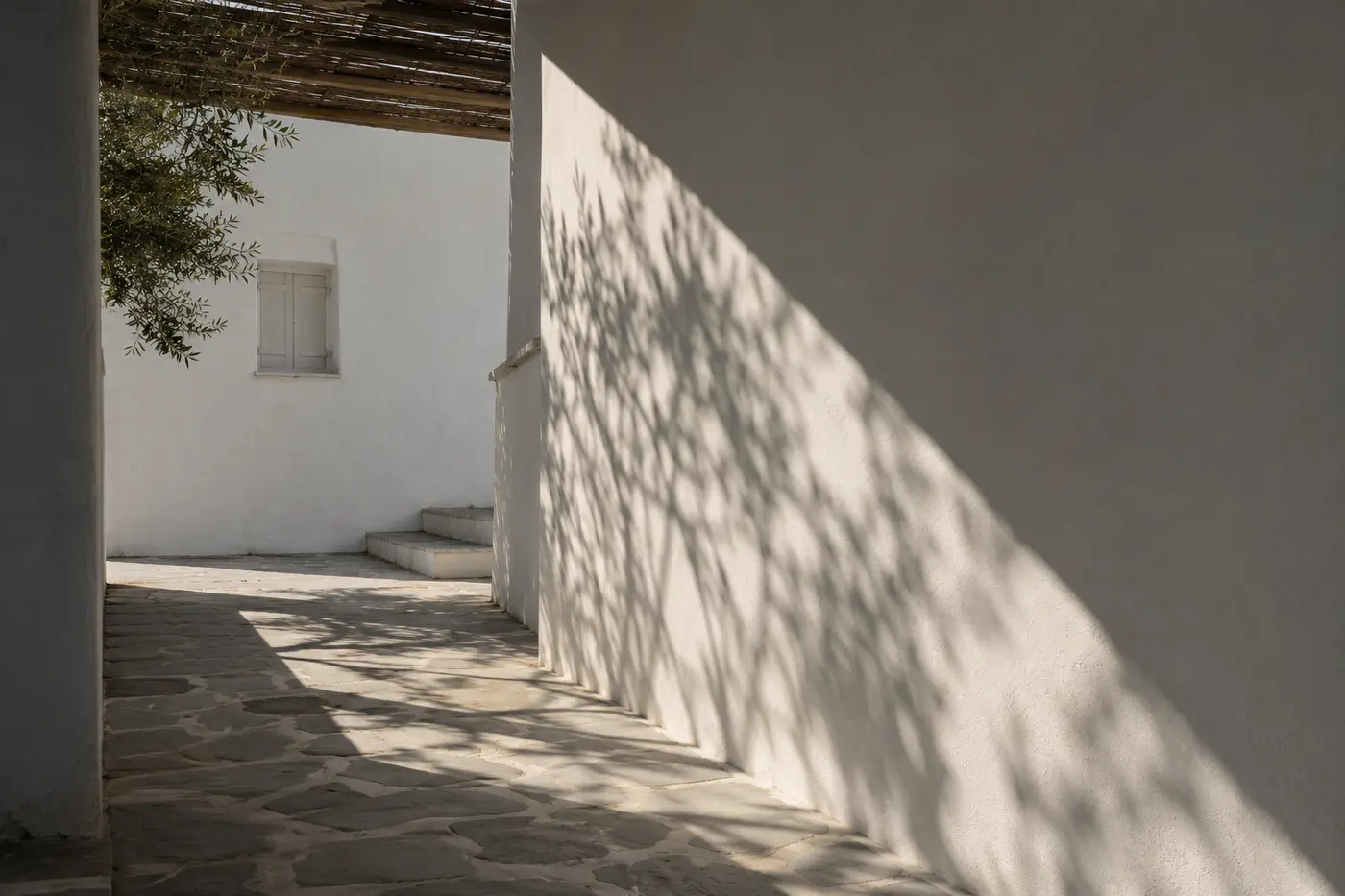
At midday, the Mediterranean landscape changes. Colours flatten. Stone becomes almost white. The air begins to shimmer. Surfaces radiate heat back into the atmosphere. Movement slows. Without shade, the landscape becomes almost impossible to inhabit.
As landscape architects, we are trained to think about shade long before we think about objects. A tree is not simply vegetation. A pergola is not simply structure. A wall is not simply enclosure. Each becomes an instrument that shapes comfort, movement and perception throughout the day.
Designing Mediterranean landscapes means designing where people will choose to stand at two o'clock in the afternoon. It means understanding that a shadow is never static. It moves. It stretches. It contracts. It gradually redraws the landscape from sunrise until dusk.
In this way, shade becomes a form of geometry. Not drawn with lines, but with time.
The Cycladic islands offer countless lessons in this relationship. A narrow alley appears almost monochromatic until a sharp band of shadow cuts across its whitewashed wall. A staircase gains depth as each step alternates between brightness and darkness. A limestone surface that seems perfectly smooth at noon suddenly reveals every grain, pore and imperfection as the sun lowers. Nothing about the material has changed. Only the light. More precisely, only the shadow.
Landscape architecture teaches us that perception is dynamic. Materials are never experienced independently from climate. Stone, concrete, timber and clay reveal different qualities depending on temperature, humidity and the angle of the sun.
A surface is not a fixed object. It is an event that changes continuously throughout the day.
This understanding has shaped the way I look at ceramics. I rarely begin by considering the object itself. Instead, I imagine the environment in which it will exist. Morning light entering a kitchen. Late afternoon sun across a dining table. A shadow cast from a nearby window.
The object becomes part of a much larger choreography between material, architecture and atmosphere. Its proportions are only half of the design. Its relationship with light completes it.
This is why Surface + Shadow became the first Study. Rather than exploring form alone, it investigates how light reveals form.
A perfectly smooth vessel is never truly smooth. As shadows move across its surface, curves become deeper, edges sharper and textures more pronounced. The object appears to transform without ever changing. This is not an optical illusion. It is a reminder that perception is always relational.
Landscape architects understand this instinctively. We never design isolated objects. We design relationships. Between people and climate. Between vegetation and architecture. Between movement and rest. Between sunlight and shade.
Ceramics can operate in exactly the same way. A bowl is not only defined by its profile. It is defined by the shadow it casts. A vessel is not only shaped by clay. It is shaped by the light that eventually touches it.
Perhaps this is why I find myself photographing shadows far more often than objects. A tree canopy projected onto limestone. The edge of a pergola stretching across a courtyard. The cool refuge beneath an olive tree. The changing geometry of a white wall throughout the afternoon.
These are not simply beautiful moments. They are lessons in spatial design.
They remind me that the Mediterranean has always been an architecture of climate before it became an architecture of form. Long before mechanical cooling, comfort was created through orientation, proportion, vegetation and carefully positioned shade.
These principles remain profoundly contemporary. In an era of rising temperatures, designing shade is no longer an aesthetic decision. It is one of the most fundamental acts of landscape architecture.
Perhaps this is why the first objects developed within Me Meraki feel restrained. They are not searching for attention. Like a shaded courtyard on a summer afternoon, they aim to create quiet. To invite pause. To allow light—and shadow—to complete the design.